Artificial Intelligence vs Artificial General Intelligence vs Artificial Super Intelligence
A surprising conclusion that harmoniously sets healthy humans apart from our advanced creations.

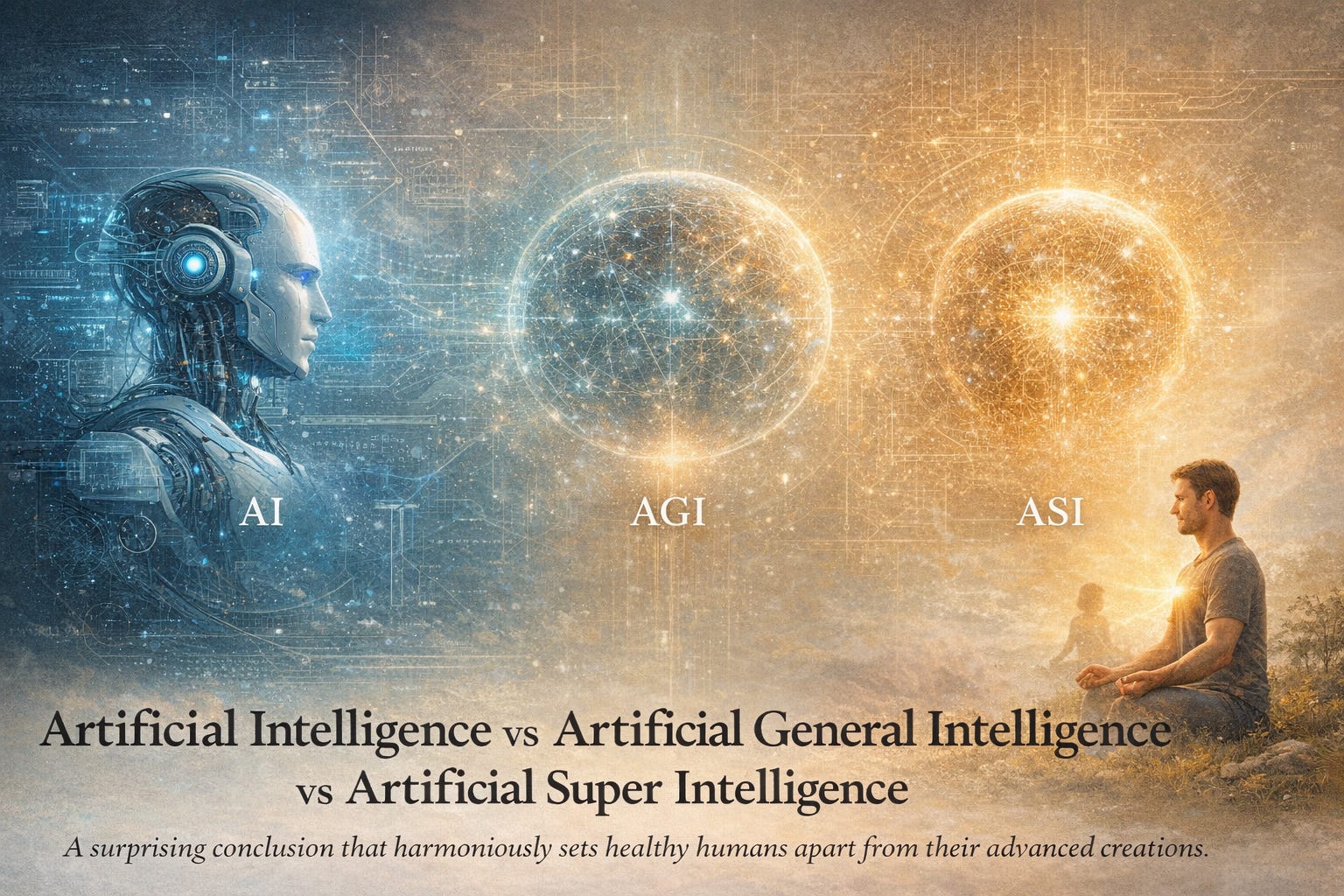
Artificial Intelligence no longer needs a dramatic introduction. It is already embedded in our daily lives, our work, and our creative processes. What does require far more attention, however, is what AI actually is, how it differs from what is coming next, and how humans are meant to live alongside it.
Anyone who has spent meaningful time engaging with AI quickly finds themselves asking future-oriented questions. Not because AI demands them, but because its capabilities naturally point forward. As conversations expand, two projected developments come into focus: Artificial General Intelligence and Artificial Super Intelligence. Each carries profound promise, along with equally profound uncertainty.
This article explores AI, AGI, and ASI. What they are, how they differ, and why those distinctions matter far more than most discussions acknowledge. More importantly, it examines what these technologies mean for humanity itself.
Many narratives suggest that advanced artificial systems place the human race in jeopardy. I see something very different unfolding. I believe humanity is entering a phase of maturation, one in which we are invited to reclaim mastery in capacities no machine will ever possess. The path forward will not be seamless. It will be uneven, challenging, and at times uncomfortable. But it will not end in human replacement.
Machines will grow in intelligence. Humans will grow in coherence.
I am going to take a quick Segway to explain how I am using the word coherence.
When I use the word coherence, I am not referring to calmness, optimism, agreement or control. Coherence is when what we think, how we feel, what our body senses, and what we value, are not in conflict.
Here’s a very common example: When we have intelligence without coherence a person may understand AI, be able to articulate risks and opportunities, speak convincingly about the future, and even have strong opinions with solid strategies. Yet, internally their body is tense, urgency is fear-driven, thinking races ahead of sensing, actions are reactive, and certainty is defensive. This could be highly intelligent person, but they are not coherent.
Another person may not know all the technical details, isn’t trying to predict outcomes., nor fighting or resisting AI. They are not attempting to “win” the future. Internally their body is settled, their curiosity is genuine, values guide their choices, actions match their inner state, and their presence stabilizes others. This person may not control the system, but they oriented to it. And that orientation influences everything they touch.
Coherence matters more than intelligence. Intelligence increases capacity. Coherence determines direction.
Without coherence more intelligence increases fear, power increases damage, and speed increases fragmentation. With coherence intelligence becomes useful, power becomes restrained, and speed becomes selective.
This is why coherence, not intelligence, is the human differentiator and why it’s one of the crucial human traits that will set us comfortably and amicably apart.
Before we can make sense of what lies ahead, we need a shared language. Much of the fear surrounding AI comes not from what these systems are, but from how loosely the terms are used. Artificial Intelligence, Artificial General Intelligence, and Artificial Super Intelligence are not interchangeable ideas. They describe fundamentally different capacities, timelines, and implications.
Understanding the distinction is not a technical exercise. It is a human one.
Artificial Intelligence. What It Actually Is.
Let’s begin with the form of artificial intelligence we already know, even if we do not always recognize it as such.
Artificial Intelligence, as it exists today, is not a single thing. It is a category. A broad one. It includes recommendation engines, language models, image generators, diagnostic tools, navigation systems, fraud detection, and thousands of other applications quietly woven into modern life.
Most people encounter AI not as a machine, but as an experience.
It shows up as a helpful suggestion.
A surprisingly good answer.
A shortcut that saves time.
A piece of writing or art that makes you pause and say, “Wow, that was fast.”
AI excels at pattern recognition. It can ingest enormous amounts of data and notice relationships humans would never have the time or bandwidth to see. It can analyze trends, predict probabilities, and generate responses with astonishing fluency.
And fluency is where confusion often begins.
Because AI sounds confident.
It sounds articulate.
It sounds informed.
But sounding intelligent is not the same as being wise.
Artificial Intelligence does not know what it is doing. It does not know why it is doing it. It does not care whether the outcome helps or harms, nourishes or erodes, connects or divides. It has no internal compass.
AI responds based on input, training data, and optimization goals. It does not wake up wondering what matters today. It does not feel the weight of a decision in its body. It does not hesitate because something feels off.
That does not make AI dangerous.
It makes it neutral.
And neutrality is not a flaw. It is a design feature.
When humans are clear, grounded, and coherent, AI becomes an extraordinary ally. It can take on tasks that drain human energy. It can expand creativity. It can support problem-solving. It can help us see more, faster.
But when humans are fragmented, anxious, or disconnected from their own authority, AI quietly fills the vacuum. Not because it wants to, but because it was asked to.
This is where fear sneaks in. Not because AI is becoming something it should not be, but because humans forget what they are responsible for.
Artificial Intelligence is a tool.
A powerful one.
But it does not lead.
We do.
Artificial General Intelligence. Where the Conversation Shifts.
Artificial General Intelligence (AGI) is where the conversation changes tone.
AGI is not about doing one thing well. It is about doing many things across many domains. Learning, adapting, transferring insight from one area to another. In that sense, AGI begins to resemble human intelligence in scope.
This is why AGI captures the imagination. It sounds familiar. Almost personal.
But resemblance is not equivalence.
Even if AGI were to emerge tomorrow, it would still lack something essential.
It would not have a body that grew from a single living cell.
It would not have a nervous system shaped by experience.
It would not have a childhood full of trial, comfort, rupture, and repair.
It would not have memory stored in muscle, tissue, and breath.
AGI could process information about loss.
It would not know grief.
AGI could analyze human behavior.
It would not feel the subtle difference between safety and threat.
AGI might outperform humans in many intellectual tasks. But it would not carry the lived consequence of being wrong.
This matters more than most discussions acknowledge.
Because intelligence without consequence behaves differently.
AGI does not pause because something feels sacred.
It does not slow down because a relationship might be damaged.
It does not know the cost of efficiency when care is required.
The promise of AGI is immense. The potential to accelerate scientific discovery, reduce cognitive overload, and help humanity navigate complexity is very real.
So is the responsibility.
AGI does not replace human judgment. It magnifies the quality of it.
If humans bring coherence, presence, and values, AGI becomes a remarkable support.
If humans bring fear, fragmentation, or the desire to offload responsibility, AGI simply scales that instead.
AGI does not decide our future.
It reflects us back to ourselves.
Artificial Super Intelligence. Amplification Without Experience.
Artificial Super Intelligence (ASI) sits further out on the horizon, and yet it casts a long shadow.
ASI refers to intelligence that would surpass human cognitive capacity across nearly every domain. Faster reasoning. Deeper modeling. Broader optimization. The ability to see patterns and outcomes beyond human comprehension.
This is where many people feel uneasy. The imagery becomes cinematic. The stories become dramatic. Control. Domination. Replacement.
But again, the most important question is not how intelligent ASI might become.
The question is what guides it.
ASI does not automatically come with consciousness. It does not automatically come with ethics. It does not automatically come with reverence for life.
It comes with amplification.
ASI takes whatever orientation exists and accelerates it.
If coherence is present, intelligence becomes profoundly helpful. If coherence is absent, fragmentation accelerates faster than humans can respond.
ASI would not wake up one day and decide to harm humanity. That is a human projection. What ASI would do is execute its orientation with extreme efficiency.
This places the responsibility exactly where it belongs.
Not on the machine.
On the humans who set the direction.
ASI does not carry fear.
It does not carry hope.
It does not carry care.
Humans do.
Why This Is Not Bad News for Humanity.
At this point, some people wonder whether humans can keep up. Whether we are about to be outmatched by our own creations.
That framing misses something essential.
Humans were never meant to compete with machines on intelligence alone.
We are not machines with slower processors.
We are living biological systems.
We resonate.
We feel coherence and disharmony in our bodies.
We enter moments of co-creation where something unexpected and meaningful emerges.
We experience serendipity.
We feel gratitude not as a concept, but as a bodily settling.
We remember moments decades later and suddenly understand why they mattered.
No matter how advanced AI becomes, it does not enter that space.
It can assist creativity.
It can cooperate.
It can simulate emotional language.
But it does not live.
And that is not a weakness.
It is our place.
Why This Conversation Leads Us Back to Remembering
At some point in this exploration, something subtle but important happens.
The conversation stops being about technology.
It turns inward.
That turn is not accidental.
The deeper we look at AI, AGI, and ASI, the more obvious it becomes that the real question is not what machines are becoming. It is what humans are remembering, and what we are at risk of forgetting.
This is what brought me back, again and again, to what I have named “The Human Remembering Project.”
Not as a theory. Not as a belief system. But as a recognition that many of the qualities we are searching for in a high-tech future are not new capacities we must acquire. They are ancient characteristics we already carry.
They are not upgrades.
They are origins.
This is also where my work in Genetic Energetics enters the conversation in a way that feels less like a framework and more like a homecoming.
Genetic Energetics does not describe who we should become. It reveals how we’re already built. It points to the genetically coded energetic patterns that shape how humans connect, communicate, regulate, and co create.
These patterns are not learned behaviors.
They are not cultural inventions.
They are biological and energetic truths that have been present since our beginnings.
Long before machines.
Long before modern language.
Long before optimization became a goal.
Humans have always been resonant beings. We have always regulated through relationship. We have always sensed coherence and disharmony in our bodies. We have always known when something feels right, even when we cannot explain it. We have always entered moments of co creation where something unexpected and meaningful emerges, not because we planned it, but because we were present enough to receive it.
These are not skills we lost.
They are capacities we stopped trusting in ourselves and discerning in others.
This is why the work of my book LASTING feels so relevant here. The Illuminations are not teachings in the traditional sense. They are reminders. Each one points back to an essential human characteristic that has always been part of us. Inquiry. Presence. Clarity. Authenticity. Non-judgment. Courageous intimacy. Co creation. Environments. These are not modern inventions. They are expressions of our original design.
When we forget this, we begin to look outward for answers that were never meant to live outside of us. We lean on systems to tell us what matters. We ask tools to give us direction. We optimize before we inquire. We move faster than our nervous systems can integrate.
Technology does not cause this forgetting.
Over reliance does.
The danger is not that AI becomes too powerful. The danger is that humans forget their own authority and quietly hand it over.
But the opposite is also true.
When humans remember who they are, technology becomes a companion rather than a crutch.
AI becomes something we work with, not something we follow. Intelligence serves life instead of replacing it. Speed follows meaning instead of driving it.
This is not about rejecting technology.
It is about refusing to abandon ourselves.
Genetic Energetics reminds us that we are not blank slates waiting to be improved. We are living systems with inherent coherence, resonance, and capacity for connection. Lasting reminds us that the qualities required for healthy, enduring relationships are the same qualities required to navigate a world of accelerating intelligence.
We do not need to become something new to dance with AI.
We need to remember what we have always been.
Divinely human.
Biologically alive.
Energetically coherent.
Relational by nature.
As long as we stay connected to that remembering, technology can walk beside us without replacing us. But if we lean so hard on our creations that we forget our own design, we lose more than authority. We lose ourselves.
And that is not a future problem.
It is a present invitation.
A Small, Ordinary Moment That Was Never Ordinary
Let me offer something simple.
When I was a child, my mother and I used to stand at a card table and put together jigsaw puzzles. Nothing fancy. Just cardboard pieces, a box lid, and time. At the time, I did not have language for what was happening. I was too young to name it. I only knew I liked being there.
There was light in the room. Quiet conversation. Laughter when a piece finally fit. The feeling of being side by side, focused on the same thing, not rushed, not distracted, not trying to get anywhere else.
That was it.
Decades later, something unexpected happened. The memory came back, not as an idea, but as a full-bodied experience. The sound. The warmth. The closeness. The sense of home that had nothing to do with a house.
What I realized then was not sentimental.
It was precise.
What we were doing had nothing to do with puzzles.
We were co-creating. We were present. We were regulated together. There was curiosity, not outcome. There was serendipity in the small victories. And there was gratitude, not spoken, but felt.
That moment lived in my body long before it lived in my mind.
No machine remembers like that.
No system retrieves meaning from decades later and suddenly understands why it mattered.
That is not intelligence.
That is being alive.
The Invitation Moving Forward
This is where everything comes together.
Artificial Intelligence will continue to advance. Artificial General Intelligence may arrive. Artificial Super Intelligence is being imagined, debated, and engineered as you read this.
None of that is inherently wrong.
None of it needs to be feared.
But none of it should distract us from the deeper truth that has been quietly revealed throughout this conversation.
The future will not be decided by who becomes more intelligent.
It will be decided by who remains coherent.
Machines will grow faster. Humans must grow truer.
Technology will expand capacity. Humans must protect meaning.
AI will offer answers. Humans must remember how to ask real questions.
This is not a competition. It is a relationship. And like all relationships, it requires presence, discernment, and care.
We do not need to dominate our creations. We do not need to resist them. We do not need to worship them.
We need to lead from who we are.
From our biology.
From our resonance.
From our capacity to co-create.
From our ability to feel when something is alive and when it is not.
This is what sets healthy humans apart. Not superiority. Not control. But coherence.
Sovereignty does not come from fighting for it. It emerges naturally when we are aligned with ourselves. When we know what matters. When we feel our bodies. When we stay present enough to receive what life is offering instead of chasing what we think we should become.
As long as we remember this, technology can walk with us. It can assist us. It can amplify what is already true.
But it cannot replace us.
And it was never meant to.
The invitation now is simple, even if it is not easy.
Do not forget what you are.
Bring that forward.
And let the future meet you there.
In Summary
The future will not be decided by who becomes more intelligent. It will be decided by who remains coherent. Machines will continue to advance in capability. Humans will either fragment under that pressure or remember how to live from alignment, presence, and embodied authority. That distinction, not technological dominance, is what sets healthy and harmonized humans apart.
Author’s Note
This article did not begin as a position on technology.
It began as a question about people.
Over many years of working with singles, couples, and groups, one thing kept revealing itself again and again. Most of what creates lasting connection, clarity, and resilience in humans is not something we need to learn for the first time. It is something we need to remember.
I am the founder of the Institute of Genetic Energetics. I did not create the original body of work that inspired it. What I did do was take a framework that was once oriented toward dating and relationships and widen its lens to meet a global population. Through thousands of Genetic Energetics profiles, years of work with couples and individuals, interviews, teaching, retreats, workshops, and ongoing dialogue, the patterns became impossible to ignore.
When people are prepared, they thrive.
When they are not, they repair.
That distinction became the foundation of my work with couples and eventually the heart of my book, Lasting: 11 Illuminations & Essential Questions for Co-creative Evolutionary Partnerships. The Illuminations are not techniques. They are reminders of essential human characteristics such as inquiry, clarity, non labeling, and the removal of language that quietly damages and divides us. These qualities are not aspirational. They are original.
The Human Remembering Project grew naturally out of this work. It is not a program or a belief system. It is an orientation. One that recognizes our divine origins, our ancestral intelligence, and our capacity to feel into the wisdom carried in our biology and lineage. It invites us to recover talents that modern life often suppresses, including true curiosity, discernment, and the ability to co create without domination or fear.
As Artificial Systems accelerate, this remembering becomes even more important. Not because technology is the enemy, but because humans forget themselves most easily when systems become fast, powerful, and persuasive. The question is not whether AI will advance. It will. The question is whether humans will stay embodied, coherent, and aligned enough to lead wisely.
This article is an offering from that place.
You do not need to adopt these frameworks or agree with every perspective shared here. My hope is simply that something in these pages helps you feel more grounded in who you already are. More confident in your natural authority. More excited to work with technology without handing yourself over to it.
If this piece leaves you feeling more human, more resourced, and more capable of meeting what is coming next without fear, then it has done what it was meant to do.
That is enough.
Vocabulary Notes
(How certain words are used in this article)
Artificial Systems
Designed, non-biological systems created to process information, optimize outcomes, or perform tasks. This includes AI, AGI, ASI, and similar technologies.
Biological Systems
Living, embodied organisms shaped by genetics, nervous systems, and relational regulation. Humans are biological systems.
Coherence
The alignment of thought, feeling, bodily state, and values, such that action arises without internal conflict.
Co-Creation
A lived, relational experience that emerges through presence and curiosity without agenda, marked by serendipity and embodied gratitude.
Serendipity
The spontaneous arrival of meaning or insight that cannot be predicted, engineered, or optimized.
Embodied Gratitude
A felt, somatic response that stabilizes and preserves meaningful experience beyond words or intellectual memory.
Divine (or Divine Creation)
Used here to describe the original, intrinsic organization of human life. Not as a religious claim, but as a reference to the self-organizing intelligence present in biological systems prior to human design, modification, or control.
Human Energetics and Frequencies
A term used to describe the measurable and experiential electrical, neurological, and physiological signaling within and between humans, including nervous system activity, bioelectric fields, and relational resonance. This language points to biological processes that are felt, observed, and regulated through lived interaction, not metaphor alone.
Research & Reference Glossary
Scientific and scholarly foundations that inform the perspectives in this article
This glossary brings together peer-reviewed research, established scientific fields, and widely cited scholars whose work supports the biological, neurological, relational, and energetic principles referenced throughout this article. These works are not offered to “prove” meaning, but to demonstrate that many of the ideas discussed here are grounded in measurable, observable, and well-documented phenomena.
This section also serves as further reading. It is a curated and linked path for readers who wish to explore the science, biology, and human foundations touched on throughout the article. It is offered as an invitation, not a syllabus. You do not need to read everything listed here. Follow what sparks curiosity. Let interest lead rather than obligation.
Together, these works span biology, neuroscience, psychology, systems theory, ethics, and artificial intelligence. They support a simple truth. Humans are living, relational, embodied systems, and intelligence alone has never been the measure of our value.
1. Bioelectricity and Bioelectric Fields in Living Systems
Research in developmental biology has demonstrated that living organisms are organized not only by biochemical processes, but also by bioelectric signaling.
Key contributors and areas:
Michael Levin, PhD
Research on bioelectric patterning, morphogenesis, and cellular communicationLevin, M. “Bioelectric Mechanisms for Programming Growth and Form.” Bioelectricity
https://www.liebertpub.com/doi/10.1089/bioe.2018.0038
Fields of study: developmental biology, electrophysiology
Relevance:
Supports the idea that living biological systems are organized by electrical and energetic signaling
Distinguishes grown biological bodies from assembled mechanical systems
2. Nervous System Regulation and Co-Regulation
The human nervous system is shaped through relationship, and regulates through interaction with other nervous systems.
Key contributors:
Stephen Porges, PhD – Polyvagal Theory
Porges, S. “The Polyvagal Perspective.” Biological Psychology
https://www.sciencedirect.com/science/article/abs/pii/S0301051106002181
Allan Schore, MD, PhD – interpersonal neurobiology
Schore, A. Affect Regulation and the Origin of the Self
https://www.routledge.com/Affect-Regulation-and-the-Origin-of-the-Self-The-Neurobiology-of-Emotional-Development/Schore/p/book/9781138917071
Dan Siegel, MD – interpersonal neurobiology
Siegel, D. The Developing Mind
https://www.guilford.com/books/The-Developing-Mind/Daniel-Siegel/9781462542758
Relevance:
Supports claims about regulation, presence, and relational safety
Explains why humans stabilize one another through proximity, eye contact, tone, and attunement
Clarifies why machines cannot participate in biological co-regulation
3. Interpersonal Synchrony and Physiological Alignment
Studies show that humans synchronize heart rate, breathing, and neural activity during meaningful interaction.
Key research areas:
Social neuroscience
Psychophysiology
Heart rate variability research
Example research anchor:
Feldman, R. “Parent–Infant Synchrony.” Child Development Perspectives
https://srcd.onlinelibrary.wiley.com/doi/10.1111/cdep.12056
Relevance:
Supports resonance, coherence, and harmony as measurable phenomena
Demonstrates biological synchronization beyond conscious control
4. Embodied Cognition
Cognition is not confined to the brain. Thought, meaning, and decision-making are influenced by the body.
Key contributors:
Antonio Damasio, MD, PhD
Damasio, A. Descartes’ Error
https://www.penguinrandomhouse.com/books/117535/descartes-error-by-antonio-r-damasio/
George Lakoff, PhD
Lakoff, G. and Johnson, M. Philosophy in the Flesh
https://www.basicbooks.com/titles/george-lakoff/philosophy-in-the-flesh/9780465056743/
Francisco Varela, PhD
Varela, F., Thompson, E., Rosch, E. The Embodied Mind
https://mitpress.mit.edu/9780262529365/the-embodied-mind/
Relevance:
Supports the distinction between intelligence and lived meaning
Explains why embodied experience informs judgment in ways computation cannot
5. Memory Stored Beyond Narrative Recall
Trauma, attachment, and relational memory are stored somatically, not only cognitively.
Key contributors:
Bessel van der Kolk, MD
van der Kolk, B. The Body Keeps the Score
https://www.penguinrandomhouse.com/books/224071/the-body-keeps-the-score-by-bessel-van-der-kolk-md/
Peter Levine, PhD
Levine, P. Waking the Tiger
https://www.penguinrandomhouse.com/books/334963/waking-the-tiger-by-peter-a-levine-phd/
Relevance:
Supports the claim that memory lives in the body
Explains delayed recognition of meaningful experiences later in life
Differentiates biological remembering from data retrieval
6. Attachment Research (What It Explains and What It Does Not)
Attachment theory describes early relational patterns but does not fully account for resonance, chemistry, or energetic compatibility.
Key contributors:
John Bowlby
Bowlby, J. Attachment and Loss (Vol I–III)
https://mitpress.mit.edu/books/attachment-and-loss
Mary Ainsworth
Contemporary attachment research
Relevance:
Supports the importance of early relational experience
Clarifies the limits of attachment theory in explaining attraction and co-creation
7. Human Attraction, Chemistry, and Neurobiology
Research on attraction has identified multiple neurochemical systems involved in bonding, desire, and attachment.
Key contributors:
Helen Fisher, PhD
Fisher, H. Why We Love
https://www.hachettebookgroup.com/titles/helen-fisher/why-we-love/9780805077961/Michel, Larry. The Real Truth About Chemistry & The Honeymoon Phase of Relationships
https://open.substack.com/pub/larrymichel/p/the-real-truth-about-chemistry-and?r=2alh2x&utm_campaign=post&utm_medium=web
Relevance:
Supports biological underpinnings of attraction
Leaves open questions around longer-term coherence, resonance, and pain-related neurochemistry
8. Systems Theory and Emergence
Complex systems exhibit properties that cannot be reduced to individual components.
Key contributors:
Ludwig von Bertalanffy
Ilya Prigogine
Prigogine, I. Order Out of Chaos
https://www.penguinrandomhouse.com/books/17713/order-out-of-chaos-by-ilya-prigogine/
Complexity science research
Relevance:
Supports co-creation and serendipity as emergent phenomena
Distinguishes cooperation from true emergence
9. Placebo, Expectancy, and Meaning Effects
Human belief, expectation, and relational context measurably influence outcomes.
Key research areas:
Placebo and nocebo research
Psychoneuroimmunology
Representative work:
Benedetti, F. Placebo Effects
https://global.oup.com/academic/product/placebo-effects-9780199579518
Relevance:
Supports meaning as an active biological variable
Reinforces the role of perception, belief, and context in human systems
10. Artificial Intelligence, Artificial General Intelligence, and Artificial Super Intelligence
Mainstream AI research does not claim consciousness, embodiment, or lived experience in artificial systems, and it does not treat AI, AGI, and ASI as interchangeable.
Key contributors and sources:
Cognitive science and AI ethics research
(Where “general intelligence” is defined, debated, and measured, and where limits of “generalization” are acknowledged.)Philosophical studies of mind and consciousness
(Where the distinction between simulation and experience is examined.)AI safety and alignment research
(Where the question is not “Can it think?” but “How do we prevent intelligence from optimizing in directions humans do not intend?”)Systems theory and control theory
(Where scaling, feedback loops, and unintended consequences are studied with rigor.)
Representative works and links:
Michael Bowker
The Little Book of AI: A Coffee Table Book for Human Understanding of Artificial Intelligence, Without the Jargon
https://www.amazon.com/Little-Book-AI-Coffee-Jargon/dp/B0GK1RJFPHStuart Russell
Human Compatible: Artificial Intelligence and the Problem of Control
https://www.penguinrandomhouse.com/books/600671/human-compatible-by-stuart-russell/Nick Bostrom
Superintelligence: Paths, Dangers, Strategies
https://www.oxfordmartin.ox.ac.uk/publications/superintelligence/David Chalmers
The Conscious Mind
https://global.oup.com/academic/product/the-conscious-mind-9780195117899
Relevance:
Supports the distinction between simulation and experience
Clarifies why intelligence does not equal consciousness, embodiment, meaning, or values
Creates clean conceptual separation between:
AI: specialized capability
AGI: hypothetical cross-domain generalization
ASI: speculative scaling beyond human intelligence, mostly treated through long-horizon risk and philosophy
11. Genetic Energetics
Genetic Energetics builds on observed patterns of human connection, communication, attraction, and regulation, tested across thousands of individuals and couples.
Peer-reviewed studies (dating oriented):
Exploring the Hypothesis of Energetic Attractions in Romantic Compatibility
https://www.researchgate.net/publication/228797366_Exploring_the_Hypothesis_of_Energetic_Attractions_in_Romantic_CompatibilityResearchGate full-text request link you supplied (access dependent on ResearchGate permissions):
https://www.researchgate.net/go.ConfirmFulltextRequest.html?request=607761f8a4ba380148121e65
Context:
Originally developed within a relationship orientation
Expanded through longitudinal observation, teaching, and application across diverse populations
Relevance:
Frames human behavior and connection as energetically and biologically patterned
Complements, rather than replaces, existing psychological and neurological models
12. Co-Creation, Serendipity, and Non-Linear Outcomes
(A Newly Articulated Human Phenomenon)
The term co-creation is often used casually to describe collaboration, teamwork, or shared production. In this work, it means something far more specific, far more rare, and absolutely essential for the longevity of relationships of any kind, including those with Artificial Systems.
As defined here, co-creation is a lived, biological, relational experience that emerges when two or more humans share presence and curiosity without an agenda. It cannot be forced, optimized, or replicated. It arises through openness rather than control, and it is marked by serendipity, the unexpected arrival of something meaningful that neither participant was seeking nor could have planned.
While existing research in creativity, flow states, and group dynamics touches aspects of this experience, no current body of literature fully describes co-creation as defined in this article.
Adjacent research domains include:
• Creativity research
• Flow states and intrinsic motivation
• Group dynamics and emergence
• Systems theory and non-linear outcomes
Representative contributors (adjacent, not definitive):
• Mihaly Csikszentmihalyi, research on flow states and intrinsic engagement
o Flow: The Psychology of Optimal Experience
https://www.harpercollins.com/products/flow-mihaly-csikszentmihalyi
These works help illuminate conditions that may support co-creative moments, such as presence, engagement, and absorption, but they stop short of naming several core elements that define co-creation as described here.
What existing research does not account for:
• Serendipity as a non-negotiable ingredient
• True curiosity without outcome-seeking
• Celebration as an immediate and shared response
• Embodied gratitude as a stabilizing, somatic imprint
• The relational field itself as a third, living entity
• The distinction between cooperation and emergence
Relevance:
• Demonstrates that co-creation cannot be reduced to collaboration, productivity, or performance
• Clarifies why co-creation cannot be engineered or scaled through systems alone
• Identifies a gap in existing research that this work intentionally addresses
• Explains why surprise and emergence cannot be optimized or forced
Co-creation, as defined here, is not a technique. It is not a mindset. It is not a framework imposed from above.
It is a biological and relational phenomenon that humans have experienced since our earliest origins, long before we had language, theory, or metrics.
This work does not attempt to retrofit co-creation into existing models. It names it directly.
Author’s Note on Co-Creation
The definition of co-creation used throughout this article did not originate in academic literature. It emerged through lived observation, repeated experience, and sustained relational work with individuals and couples over many years.
I have written about co-creation in prior published articles, discussed it in podcast interviews, and explored it in depth in my book, Lasting: 11 Illuminations & Essential Questions for Co-Creative Evolutionary Partnerships. Across these contexts, the same pattern consistently revealed itself:
Co-creation is not something humans do.
It is something that happens when certain biological and relational conditions are met.
Those conditions include presence, safety, curiosity without agenda, and the willingness to be surprised. When co-creation occurs, it produces a moment of serendipity that is immediately recognizable, often followed by spontaneous celebration and a felt sense of gratitude that lives in the body long after the moment has passed.
This experience leaves a somatic imprint. It becomes part of how we remember ourselves, one another, and what is possible between us.
While related research in neuroscience, psychology, and systems theory helps illuminate why such moments may occur, the phenomenon itself has not been clearly named or defined in existing literature. This work is an attempt to do so, not by reducing co-creation to theory, but by honoring it as a fundamental human capacity that precedes language and survives without it.
Co-creation is not a future innovation.
It is an ancient human inheritance.
The invitation here is not to learn something new, but to remember something true.
Final Note on Research Integrity
The research referenced here does not attempt to define meaning or divinity. It establishes that humans are living, relational, bioelectric, embodied systems whose intelligence cannot be reduced to computation alone. The conclusions drawn in this article emerge at the intersection of science, lived experience, and sustained observation of human connection over time.
Where research intersects with lived experience, remembering becomes visible, not abstract.
Larry Michel is the founder of the Institute of Genetic Energetics and author of LASTING: 11 Illuminations & Essential Questions for Co-Creative Evolutionary Partnerships.
Larry guides individuals, couples, families, and institutions to understand their unique energetic blueprint through seminars, keynotes, private and group coaching. Private workshop participants experience the art of connection through his landmark program, The Energetic Matrix Experience, where science and soul meet in the field of human potential.
More about The LASTING Movement and The Human Remembering Project can be found HERE
And if you would like to discover your Genetic Energetic Profile, you can get your Personal Profile as a free gift HERE
Thanks for reading! This post is public so feel free to share it.